The
man behind the Cronut has just published the official recipe … and it’s not for
the faint of heart.
Pastry chef Dominique Ansel invented the Cronut last year at his New York
bakery.
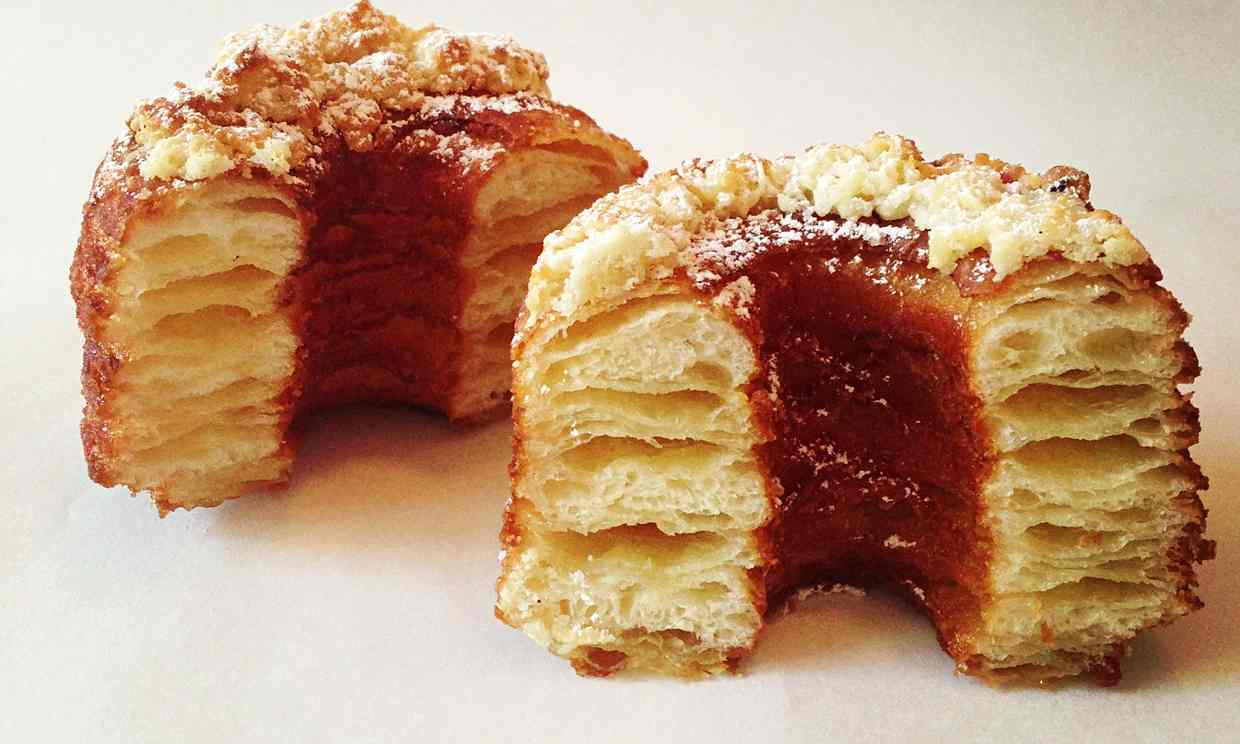
With its flaky croissant and custard interior and fried, sugar-dipped exterior,
it was bound to be popular –
but no one could have predicted the ensuing, pastry-flecked frenzy.
Just days after Ansel started selling the croissant-donut hybrid in May 2013,
things got crazy.
Lines formed at the doors at 6am, news crews camped outside the bakery, and a
thriving Cronut black market sprang up on Craigslist.
The canny Ansel trademarked his Cronut, but that hasn’t stopped doissants and
fauxnuts springing up across the globe.
His new cookbook, Dominique Ansel: The Secret Recipes, features many elegant
and inventive confections,
though of course there’s one getting all the attention.
The not-so-secret Cronut recipe is now plastered all over the internet.
But would-be imitators will need their piping bags and patience at the ready –
this one is best left well alone if the most complicated thing you’ve ever
baked is a lemon drizzle.

Ansel prepares to deep fry a batch of Cronuts. Photograph: Andrew Burton/Getty
Images
The official Cronut takes three days to make, thanks in part to the laminated
dough.
This is rolled together with a block of chilled butter to form layers, and
needs a lengthy rest in the fridge.
Ansel takes things to the next level, however. Two days before you’re allowed
near the fryer, you must make a dough square.
For unexplained reasons, you also have to make the ganache 48 hours ahead of
time.
On day two, you get the dough out of the fridge and roll it with a perfect
square of butter made using parchment and a ruler.
Then back in the fridge it goes until day three – a frenzy of frying, glazing,
flavoured sugar and piping work.
The equipment list specifies a stand mixer with dough hook (cost £250-£400),
the ruler, piping bags and a deep-frying thermometer.
It may be lengthy, and require a decent level of kitchen experience, but the
most surprising thing about Ansel’s “secret” recipe is that it contains no
great secrets.
“The only thing that surprises me is that it isn’t a bit more different,” says
former Bake Off winner Edd Kimber, who has just published his own patisserie
cookbook
and created a fauxnut recipe last year. “Ansel has said in the past that it’s
different to a croissant dough, but looking at the recipe, the technique is
very similar.
There’s the addition of a little egg white and cream, so it’s almost like a
croissant dough with a bit of Danish recipe thrown in.”
The secret of the Cronut has been solved.
It takes three days and a lot of sugar, butter and graft. One question remains,
however: will anyone have the patience to make their own?
DIY Cronuts: Edd Kimber's lemon and vanilla fauxnuts. Photograph: Edd Kimber
Frying fauxnuts. We've got our eye on those sizzling middles: chef's
perks. Photograph: Edd Kimber
***************************************************************
Lemon and vanilla fauxnuts recipe
(makes 10)
Double batch of 20-minute croissant dough
For the glaze:
100g caster sugar
Zest and juice of 1 lemon
Icing sugar
For the filling:
300ml whole milk
1 vanilla bean
4 large egg yolks
2tbsp plain flour
50g caster sugar
Before frying your fauxnuts, make the lemon sugar, the filling and the glaze.
For the filling place the milk into a saucepan and set over medium heat. Using
a sharp knife scrape out the vanilla beans from the pod and place into the pan
with the pod itself.
Add the egg yolks, flour and sugar into a bowl and whisk together until smooth.
When the milk comes to the boil remove the vanilla pod and then pour the milk
over the eggs, whisking to combine.
Pour the custard back into the pan and heat until thickened, whisking
constantly. Return the custard to the bowl, cover with clingfilm and refrigerate
until needed.
For the lemon sugar, rub the zest and sugar together for a few minutes, cover
and set aside.
To make the glaze, add icing sugar to the lemon juice until you have a pipeable
mixture with a thickness similar to toothpaste.
Press clingfilm on to the surface of the glaze, to prevent it crusting over,
and set aside until needed.
When you are ready to fry your fauxnuts, fill a thick-bottomed saucepan
two-thirds full with vegetable oil, place over a medium heat and bring to 170C.
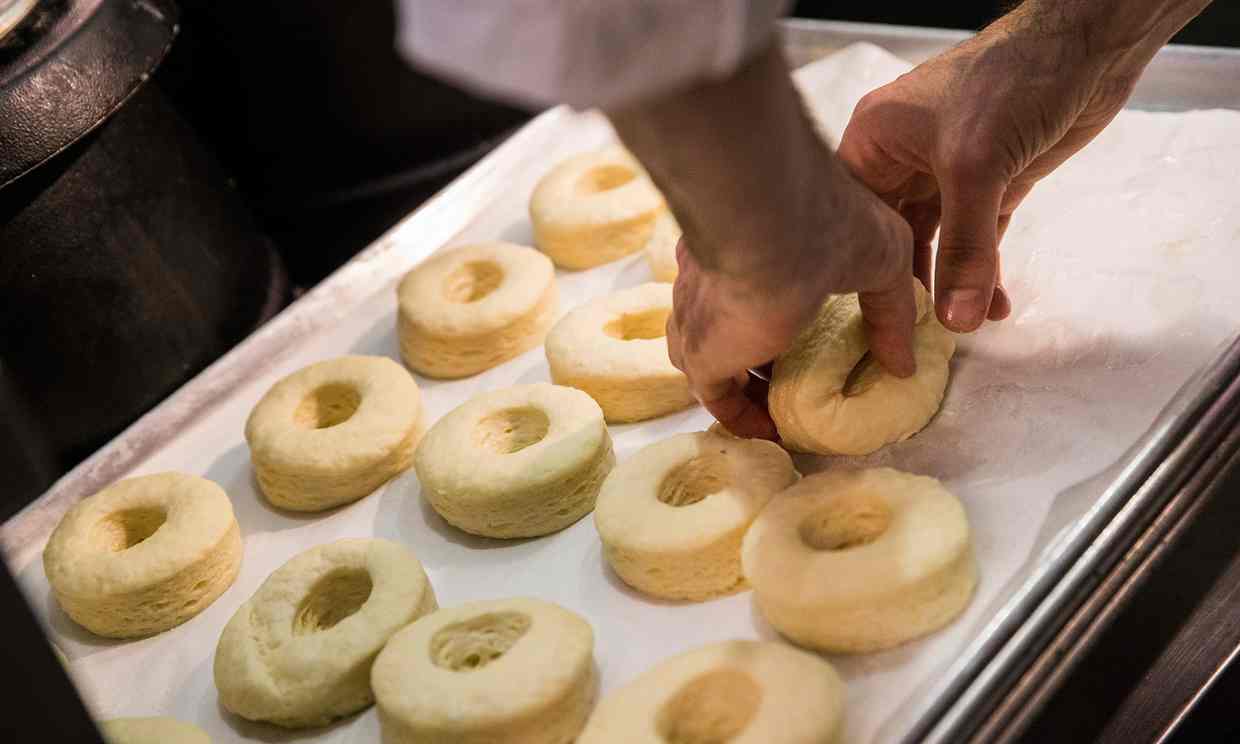
While the oil is heating, roll out the dough to about 1cm thick. Using a 3.5in
cookie cutter, cut out 10 doughnuts and then using a 1in cutter, cut out the
hole in the middle.
When the oil is at temperature, fry two fauxnuts at a time for a couple of
minutes each side, or until deep golden brown.
Using a metal slotted spoon remove from the pan and place on to a wire rack
covered with kitchen paper.
Once they have cooled enough for you to handle them, roll the outside in the
lemon sugar, then set aside to cool completely.
Place the vanilla custard filling into a piping bag fitted with a bismarck tip.
Press the tip into each quarter of the fauxnuts and pipe in a small amount of
the custard.
Put the glaze into another piping bag, snip off the end, and pipe a ring around
the top.
These are best eaten as close to assembling as possible, while still crisp,
although they were still delicious within a few hours.
Chances are, you won't have any lying around long enough to find out though.
Source: theguardian.com/lifeandstyle/2013/jun/05/edd-kimber-lemon-vanilla-fauxnuts-recipe
Recipe By:Chef
John
"Cronuts are
the donuts that make people go nuts! They have the shape and flavor of a
doughnut, yet feature the crispy, flaky texture of a buttery croissant. In Part
I, I'll show you how to make the dough; in Part II, we'll fry, eat, and
analyze."
*****************************
Cronuts
Ingredients
- 1 (.25 ounce)
package active dry yeast
- 1/2 cup warm
water (105 degrees F/41 degrees C)
- 1 teaspoon
fine salt
- 2 1/2
tablespoons white sugar, or more to taste
- 1/2 cup milk
- 2 tablespoons
butter, melted
- 1 teaspoon
vanilla extract
- 1 large egg
- 1/8 teaspoon
freshly grated nutmeg
- 1 pound
all-purpose flour
- 12 tablespoons
European-style (low-moisture) butter at room temperature, divided
Directions
- Place yeast into the mixing bowl of a
large stand mixer. Whisk in warm water and let stand until a creamy foam
forms on top, about 5 minutes.
- Add salt, sugar, milk, 2 tablespoons
melted butter, vanilla extract, egg, and nutmeg.
- Whisk mixture thoroughly. Pour flour on
top of liquid ingredients.
- Place mixing bowl onto mixer.
- Attach dough hook to mixer and knead on
low speed until dough comes together in a ball and becomes soft and
sticky, about 3 minutes.
- Dough will stick to the hook and pull
away from the side of the bowl.
- Transfer dough to a floured work
surface, knead 2 or 3 times, and shape into a ball.
- Wrap dough in plastic and refrigerate
for 20 minutes to let gluten relax.
- Remove dough from refrigerator, unwrap,
and dust lightly with flour.
- Roll out into a 9x18-inch rectangle
about 1/4 inch thick.
- Evenly spread 6 tablespoons softened
unsalted butter onto the middle third of the dough.
- Fold one unbuttered third over the
buttered third and press lightly; spread remaining 6 tablespoons of
unsalted button on top of that third.
- Fold remaining third over the
first (buttered) third. Transfer dough onto a sheet pan, cover lightly
with plastic wrap and a kitchen towel, and refrigerate 20 to 30 more
minutes for butter to become firm.
- Sprinkle dough lightly with flour as you
work if it becomes sticky.
- Return dough to floured work surface and
pat very gently into an 8x14 rectangle about 1/2-inch thick.
- Fold outer thirds over center third as
before; roll out into an 8x14-inch rectangle again.
- Keep edges of rectangle as straight as
possible. Fold in thirds as before.
- Cover dough lightly with a kitchen
towel, and refrigerate for 2 hours.
- Roll the dough out to about 3/8 inch
thick. Cut dough in half crosswise.
- Leave half on a lightly floured work
surface; refrigerate other half of dough until needed.
- Use a sharp 3-inch circular cutter to
cut 8 circles of dough from piece on the work surface.
- Use 1-inch size cutter to cut the donut
holes out of the dough circles.
- Line a baking sheet with waxed paper and
sprinkle lightly with flour.
- Arrange cronuts and holes onto prepared
baking sheet.
- Let rise in a draft-free, warm
place (such as an unheated oven) until doubled in size, about 1 hour.
ALL RIGHTS RESERVED © 2016 Allrecipes.com
*************************************
Save these recipes as pictures